
Hiring a builder is one of the biggest spending decisions a homeowner or business owner makes. Whether you are planning a rear extension, a loft conversion, structural alterations or a shop fit-out, the company you choose will shape the cost, the timetable and the quality of the finished work for years.
This guide explains what to check, which questions to ask, how quotes and contracts should work, and which warning signs should make you walk away. It is written for homeowners and businesses, and the principles apply anywhere in the UK.
Key points
- Match the builder to the job: ask for evidence of similar projects.
- See insurance certificates and check any scheme membership at the source.
- Prefer a fixed-price, itemised quote over an estimate, and question provisional sums.
- Use a written contract with staged payments tied to completed work.
- Check planning permission, Building Regulations and party wall requirements before work starts.
In this guide
- Start with the type of work you need
- What to check before you hire
- Fixed-price itemised quotes versus estimates
- Contracts and staged payments
- Planning permission and Building Regulations basics
- Questions to ask a builder
- Warning signs of rogue builders
- What to expect once work starts
- How GSMS Construction works with clients in London
- Talk to GSMS about your project
- FAQs
Start with the type of work you need
Builders differ in what they do well. A firm that mainly does decorating and small repairs may not be set up for reinforced concrete (RC) frames, groundworks or structural steel. Before you request quotes, write a short description of the job: what you want built, roughly where, and any deadlines. Then look for firms with evidence of similar work, such as photos of finished projects, descriptions of past jobs and clients you can ask about.
For businesses, relevant experience matters even more. A retail or commercial fit-out often has to fit around trading hours, landlord requirements and fixed opening dates.
What to check before you hire
Insurance
Ask for proof of insurance, not just a statement that the firm is insured. Public liability insurance covers damage to third parties and their property. If the builder employs staff, employers’ liability insurance is a legal requirement in most cases. Ask to see the certificates, check the dates and check that the cover matches the type of work. If you are working on a building you own, also tell your own buildings insurer about the project.
Trade bodies and schemes
Several organisations and schemes exist in the UK construction industry. Membership can be a useful extra check, but it is not a legal requirement for builders, and it is not a guarantee of quality on its own. Examples you may come across:
- Competent person schemes allow registered installers to self-certify certain work (such as electrical, gas or window installation) as compliant with Building Regulations.
- Trade associations such as the Federation of Master Builders, or other builders’ associations, publish membership standards and often offer a complaints process.
- Trust and vetting schemes check businesses against criteria such as references and financial standing.
- Health and safety assessment schemes such as CHAS or Constructionline are often asked for on commercial and public sector work.
If a builder says they belong to a scheme, check the claim directly on the scheme’s own website. Do not rely on a logo on a van or brochure. Also remember that a firm without a particular membership can still be capable and reliable; what matters is that you can verify the things that count: insurance, references, written terms and a track record.
Written guarantees
A guarantee is only as good as its wording. Ask for it in writing and check:
- how long it lasts and what it covers (workmanship, materials, or both)
- who stands behind it if the firm closes
- how you report a problem and how quickly the builder must respond
- whether any exclusions apply
A longer guarantee shows confidence, but read the small print rather than the headline number.
VAT registration
A VAT-registered builder will show a VAT number on quotes and invoices, which you can check on the government’s VAT number checker. Registration is mandatory once turnover passes the threshold, so it shows the business is trading at a certain scale. Note that most building work for homeowners is charged VAT, with some reduced and zero rates for specific work such as certain conversions or new dwellings. Ask the builder to state clearly on the quote whether VAT is included and at what rate. Businesses that can reclaim VAT should check the position with their accountant.
Fixed-price itemised quotes versus estimates
These terms are often confused, and the difference matters.
- An estimate is a best guess. It can change as the job progresses, sometimes significantly.
- A quotation is a fixed offer to do specified work for a specified price.
A good fixed-price quote should be itemised: separate lines for groundworks, structure, roofing, windows, electrics, plumbing, plastering, finishes and so on. Itemisation lets you compare quotes like for like, spot what has been left out and agree changes without argument.
Look closely at provisional sums and prime cost (PC) sums. These are allowances for things not yet decided, such as tiles or kitchen units. They are legitimate, but if a quote contains lots of them the final bill can rise. Ask what is and is not included, and how variations will be priced and agreed.
Get at least three quotes where you can, and be wary of any that are far lower than the rest. A very low price often means something has been omitted or corners will be cut.
Contracts and staged payments
Do not start work on a handshake. A written contract protects both sides and should set out:
- a full description of the work and reference to drawings and specification
- the price and what it includes, plus VAT
- start date, expected duration and what happens if there are delays
- the payment schedule
- how changes (variations) are agreed in writing
- insurance details and the guarantee
- how disputes will be handled
Staged payments should be linked to completed milestones, for example completion of foundations, structure watertight, first fix, and final completion. Avoid paying a large deposit upfront. Be cautious if a builder asks for a big sum in cash before they have started, or for materials money before an order is placed. Keep records of every payment and agree to inspect each stage before you pay for it.
Planning permission and Building Regulations basics
These are two separate systems, and many people confuse them.
Planning permission concerns whether the development is acceptable in land-use terms: its size, appearance and impact on neighbours. Many smaller projects, including some rear extensions and loft conversions, can fall under permitted development rights, but these have conditions and limits, and they do not apply in the same way to flats, maisonettes or properties in conservation areas or with Article 4 directions. Always check with your local planning authority, or apply for a lawful development certificate if you want certainty.
Building Regulations cover how the work is built: structure, fire safety, insulation, drainage, ventilation, electrics and more. Most extensions, loft conversions and structural alterations need Building Regulations approval, even where planning permission is not required. An inspector from the local authority or an approved private inspector visits at key stages and signs off the work at the end. Keep that completion certificate, because you will need it when you sell.
If your building is shared, or you are building near a boundary, you may also need to follow the Party Wall etc. Act 1996 and serve notices on neighbours. Ask your builder who will handle each of these steps and make sure it is written down.
Questions to ask a builder
- Can I see examples of similar projects, and can I speak to past clients?
- Who will actually do the work, your own team or subcontractors?
- Who will supervise the site day to day?
- Is your quote fixed price and itemised?
- What insurance do you hold, and can I see the certificates?
- What guarantee do you give, and what does it cover?
- Who handles Building Regulations and any structural engineer’s input?
- What is the start date, duration and payment schedule?
- How will you handle changes and unforeseen problems, such as poor ground conditions?
- How do you protect the rest of the property and keep the site safe?
A reliable builder will answer these directly and without irritation.
Warning signs of rogue builders
- Pressure to decide immediately or “today only” prices
- Cold callers who say they have noticed a problem with your roof or driveway
- No fixed address, only a mobile number and no verifiable business details
- Reluctance to provide written quotes, contracts or insurance proof
- Requests for large cash payments upfront
- A price far below all the others
- No VAT number on paperwork when you would expect one
- Dismissing planning permission or Building Regulations as unnecessary
- Vague answers about who will do the work
If several of these appear together, walk away.
What to expect once work starts
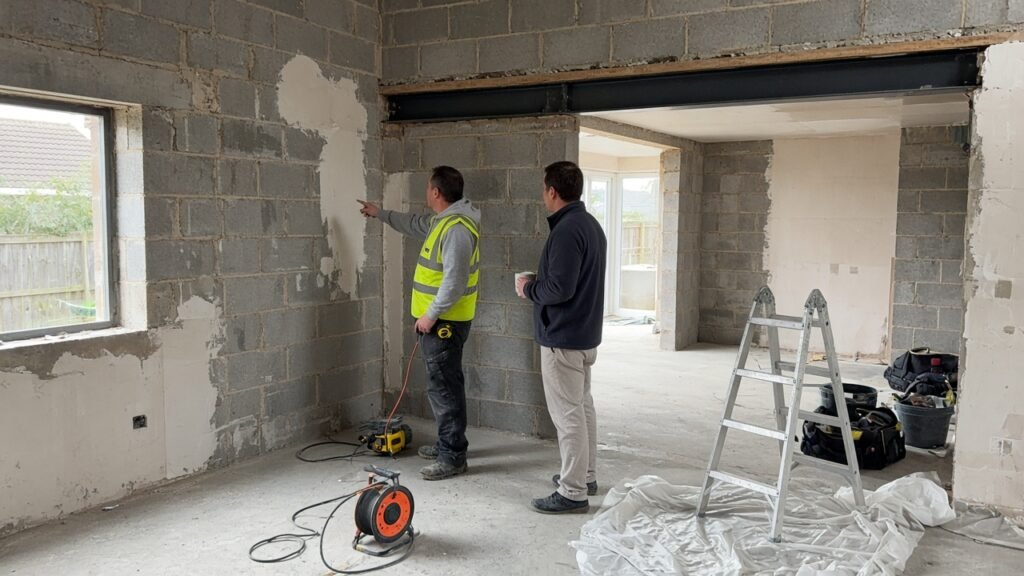
A well-run job begins with a pre-start meeting: confirm access, working hours, parking, storage of materials, protection of floors and how waste will be handled. Expect:
- Early groundworks and structure to be the noisiest and messiest phase, with deliveries and skips.
- Regular communication, ideally a named contact and an agreed way to get updates.
- Inspections by Building Control at set stages. Do not let the builder cover up work before it has been inspected.
- Changes put in writing with the cost and time impact before they are carried out.
- A snagging list at the end, which is a walk-round to note small defects the builder must fix before you make the final payment.
Hold back the final payment until snagging is complete and you have received all certificates and guarantee paperwork.
How GSMS Construction works with clients in London
GSMS Construction Ltd carries out RC frames, extensions, loft conversions, groundworks, commercial fit-outs and renovations for clients in London. Past projects include a Morrisons Daily retail fit-out and the renovation of Global Fresh Bazaar in Ilford.
Here is how the company works:
- Free site survey so the scope can be properly understood before a price is given
- Fixed-price, itemised contracts so you can see what you are paying for
- 5-year workmanship guarantee
- Fully insured and VAT registered
Opening hours are Monday to Saturday, 9am to 5pm.
Talk to GSMS about your project
If you are planning an extension, loft conversion, groundworks, fit-out or renovation in London, book a free site survey. Call 07717 790273 or email info@gsmsconstructionltd.co.uk, or send us your project details.
Related reading: house extensions in London, home renovations and our RC frame and formwork service.
FAQs
1. How do I know if a builder is reliable? Check proof of insurance, ask for references and examples of similar completed work, get a written itemised quote and contract, and verify any scheme memberships or VAT numbers directly with the issuing body.
2. What is the difference between a quote and an estimate? An estimate is an approximate cost that can change. A quote is a fixed price for defined work. An itemised fixed-price quote makes it easier to compare builders and avoids surprises.
3. How much deposit should I pay a builder? There is no single rule, but large upfront payments are risky. Link payments to completed stages of work and agree the schedule in the contract before work starts.
4. Do I need planning permission for an extension or loft conversion? Not always. Some projects fall under permitted development, but limits and exceptions apply, especially for flats and conservation areas. Check with your local planning authority. Building Regulations approval is usually needed either way.
5. What insurance should a builder have? Public liability insurance is the baseline, and employers’ liability is generally required if they employ staff. Ask to see current certificates and check the cover is suitable for your project.
6. What should a workmanship guarantee include? It should be in writing and state the length of cover, what is covered, how to make a claim and any exclusions. GSMS Construction offers a 5-year workmanship guarantee.